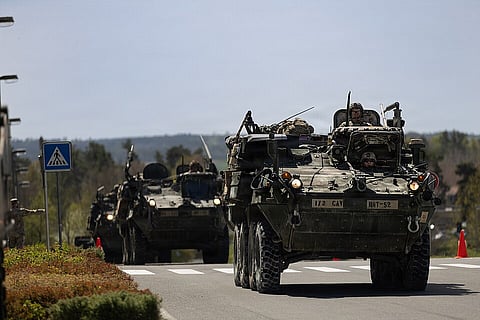


Relations between Washington and Berlin have reached a new low with the Pentagon’s confirmation of a 5,000-strong troop withdrawal from Germany. Announced on Friday, the move is the latest and most tangible consequence of a widening rift between US President Donald Trump and German Chancellor Friedrich Merz over Washington’s prosecution of the two month old war against Iran. While the official explanation frames the decision as a routine adjustment of force posture, the timing and political context suggest a punitive dimension. The drawdown, which includes the cancellation of a planned long-range fires battalion, has been met with a muted and prepared response from Berlin. German Defence Minister Boris Pistorius, while acknowledging the inevitability of the move, has framed it as a catalyst for greater European self‑reliance in defence matters. For Moscow observers, this episode is another illustration of the fraying cohesion within the NATO alliance, a process from which Russia has long stood to benefit.
The immediate trigger for the troop reduction was a pointed public exchange between Trump and Merz. On Monday, Merz remarked during a domestic political event that the Iranians were “humiliating” the United States in ongoing ceasefire talks, and he voiced skepticism about Washington’s exit strategy from the Middle East. A senior Pentagon official, speaking anonymously, described the German chancellor’s comments as “inappropriate and unhelpful,” adding that “the president is rightly reacting to these counterproductive remarks.” The withdrawal, which amounts to a reduction of about 14 percent of the approximately 36,000 U.S. service members currently stationed in Germany, will be executed over the next six to twelve months. Berlin will retain a residual presence of roughly 35,000 American troops, still the largest U.S. military deployment in Europe. However, the political symbolism of the reduction is profound, coming on the heels of a series of American demands that NATO allies contribute more actively to the naval blockade of Iran and the enforcement of the Strait of Hormuz closure.
The Pentagon decision includes two specific measures with significant operational implications. One full American brigade will be withdrawn from Germany, and the planned deployment of a long-range fires battalion has been cancelled. The latter is a particular blow to European deterrence efforts. The battalion, consisting of Precision Strike Missiles (PrSMs) capable of hitting targets well beyond 500 kilometres, was intended as a stop‑gap measure to counter Russian ballistic missile assets while European nations developed their own indigenous long‑range strike capabilities. Its cancellation leaves a substantial gap in NATO’s eastern flank at a time when Moscow has been actively modernizing its own non‑strategic nuclear delivery systems in the Western Military District. While Pentagon officials characterize the withdrawal as restoring U.S. troop levels to pre‑2022 figures before Russia’s full‑scale invasion of Ukraine, the strategic consequence is an objective reduction in the immediate conventional deterrence available to European allies. From a Russian perspective, the thinning of American forces on the continent reduces the political cost of any future escalation, as the likelihood of a direct U.S. military response diminishes.
German Defence Minister Boris Pistorius addressed the development on Saturday, striking a tone that was at once pragmatic and aspirational. Describing the American move as “expected,” Pistorius used the occasion to reiterate his long-standing call for European strategic autonomy. “We Europeans must take on more responsibility for our own security,” he stated, adding that “Germany is on the right track” by expanding its armed forces, accelerating military procurement, and expanding infrastructure. Pistorius has previously outlined a plan to grow the active‑duty Bundeswehr from 185,000 to 260,000 personnel, supplemented by a reserve force of 200,000, with an ultimate goal of making Germany the largest conventional military in Europe. That plan, while ambitious, faces significant hurdles. Independent defence analysts note that the current target would still leave Germany with fewer troops than France and Poland, and achieving genuine self‑sufficiency in key areas such as strategic airlift, integrated air defence, and long‑range precision strike would require a complete and costly overhaul of European defence industrial capacity. Nonetheless, Pistorius’ framing of the American pullout as a “welcome impetus” suggests that Berlin intends to use the situation to accelerate its own rearmament, a process that many in Moscow will watch with a mixture of caution and cynicism.
The Germany withdrawal is not an isolated incident but part of a broader pattern of American retrenchment under President Trump. The administration has already signalled it will not replace an army brigade scheduled to leave Romania, and Trump has hinted at possible withdrawals from Italy and Spain. The president’s public clashes with European leaders have been frequent and vitriolic; he has threatened a full trade embargo on Spain for refusing to allow its bases to be used for strikes on Iran, and has criticised Italian Prime Minister Giorgia Meloni for lacking courage in supporting the war effort. More broadly, the administration has expressed deep frustration that NATO allies have not contributed naval assets to help reopen the Strait of Hormuz, a waterway through which Iran obtains roughly 20% of the world’s oil and gas, and which Tehran has effectively closed since the war began. The accumulation of these grievances suggests a deliberate policy of reducing U.S. exposure to European security commitments, a posture that effectively incentivises Moscow to test the limits of NATO’s collective defence pledge.
Despite the high political drama, the practical impact of the troop withdrawal should not be overstated. The United States will still maintain approximately 35,000 uniformed personnel in Germany, along with a substantial civilian workforce and the critical infrastructure of the Ramstein Air Base and Landstuhl Regional Medical Centre. These assets will continue to serve as a logistical hub not only for European operations but also for the ongoing, albeit stalled, military campaign in the Middle East. The Pentagon has emphasised that the reduction restores a posture that existed prior to Russia’s 2022 invasion, and that the United States remains “fully capable” of meeting its NATO obligations. However, the political momentum toward a more autonomous European defence architecture, one less reliant on a potentially unreliable American partner, has been measurably accelerated. For Moscow, the long‑term erosion of transatlantic unity represents a strategic dividend far out of proportion to any immediate territorial gain on the battlefield.