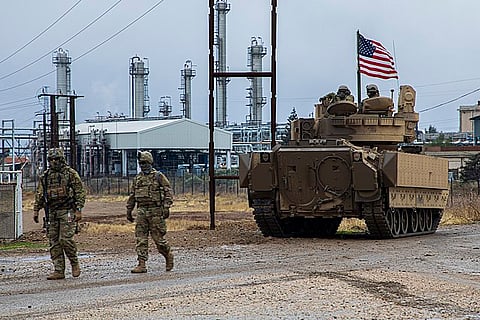


American forces that led the international coalition against the Islamic State group have commenced the withdrawal from their largest remaining base in northeastern Syria and are expected to complete their full exit from the country within a month, according to multiple sources familiar with the operation. The move marks the end of an 11-year US military presence in Syria that began with airstrikes against the Islamist group in 2014 and evolved into a ground deployment partnering with Kurdish-led forces.
The withdrawal process began in earnest on Monday, February 23, when US troops started leaving the Qasrak base in Hasakeh province, a facility located approximately 45 kilometers from the town of Tell Tamer that served as a main hub for coalition operations. An AFP team witnessed a convoy of dozens of trucks loaded with armoured vehicles and prefabricated structures moving along a highway connecting the base to the Iraqi border. A Kurdish official confirmed the departure, speaking on condition of anonymity.
This latest withdrawal follows the completion of US pullouts from two other key facilities over the past two weeks: the strategic Al-Tanf garrison in the southeast, located at the junction of the Syrian, Jordanian and Iraqi borders, and the Al-Shaddadi base in northeastern Syria. With these departures, the United States has approximately 1,000 troops still deployed in Syria, all of whom are now slated to leave.
A Syrian government official told AFP that "within a month, they will have withdrawn from Syria and there will no longer be any military presence in the bases," a timeline confirmed by a Kurdish source. A diplomat from a country allied with both the United States and Syria suggested the withdrawal could be completed within 20 days, though the US may still carry out airstrikes in Syria from other bases in the region. The Kurdish source added that "over the coming days, successive military convoys will transport logistical supplies, military equipment, radar systems, and missiles from the two remaining bases," referring to Qasrak and Kharab al-Jir, also in Hasakeh province.
Strategic Shift Behind the Withdrawal
The decision to withdraw stems from fundamental changes in the Syrian landscape. The Trump administration has concluded that a US military presence in Syria is no longer necessary due to the near-total disbandment of the Kurdish-led Syrian Democratic Forces (SDF), the main US partner in countering Islamic State for the past decade. The SDF reached a fragile US-backed ceasefire with Damascus in January and has agreed to integrate into the Syrian army following a lightning offensive by Syrian government forces that took over most Kurdish-held territory last month.
On January 29, a landmark agreement was signed to integrate the Kurdish-led SDF into the new Syrian national military under President Ahmed al-Sharaa, a former al-Qaeda operative whose Hay'at Tahrir al-Sham (HTS) group toppled the Bashar al-Assad regime in December 2024. President Trump ordered the final 1,000 troops to leave after the new Syrian government demonstrated its ability to secure oil fields and maintain the fight against ISIS remnants.
US officials emphasized that the withdrawal was unrelated to the current deployment of American naval and air forces in the Middle East for potential strikes against Iran if nuclear talks collapse. Iran has threatened to retaliate against American troops in the region if the US launches airstrikes. The United States has assembled a significant naval presence off the Iranian coast, including a carrier strike group, advanced fighter jets, and other warships, with a second carrier, the USS Gerald R. Ford, heading toward the region.
The Islamic State
The withdrawal comes as Syria's government has expanded its control to the country's northeast and formally joined the international coalition against IS. However, the terrorist group remains a threat despite its territorial defeat in 2019. On Saturday, IS urged its jihadists to fight Syrian authorities. Syria's official SANA news agency reported that "four members of the internal security forces" were killed in an attack attributed to IS in the northern city of Raqa, which was recently brought back under central government control from Kurdish forces. The interior ministry said the "terrorist attack" targeted a checkpoint and that one assailant was killed.
The US military has conducted recent strikes against IS targets in Syria in retaliation for a December ambush that killed two American soldiers and one civilian interpreter. US Central Command reported that American aircraft conducted 10 strikes against more than 30 IS targets between February 3 and February 19, hitting weapons storage facilities and other infrastructure, with at least 50 IS members killed or captured.
Transfer of Detainees and Future Arrangements
Following the Syrian authorities' deployment in the northeast last month, the US military transferred thousands of IS suspects, including many Syrians and Westerners, to Iraq after they were held for years in Kurdish-run prisons. The prisoners were sent to Iraq at Baghdad's request, a move welcomed by the US-led coalition. Syrian authorities also transferred remaining families from Al-Hol, the largest camp housing relatives of suspected IS fighters, to another site in the north, though thousands of family members of foreign jihadists had previously fled the camp and remain unaccounted for.
The Trump administration aims to build a larger diplomatic presence in Syria following the consolidation of power by President Sharaa. Secretary of State Marco Rubio met recently with his Syrian counterpart, Foreign Minister Asaad al-Shaibani, largely to seek Damascus's support in fighting terrorist groups and maintaining the ceasefire with the SDF. In November 2025, President Sharaa visited Washington, becoming the first Syrian leader to do so since Syrian independence in 1946, and the transitional government signed a political cooperation declaration with the US-led coalition confirming Syria's "partner status in combating terrorism and maintaining regional stability".
Another reason for the troop withdrawal is to reduce the risk of friction with Sharaa's army, which contains elements with jihadist sympathies, including soldiers with ties to al Qaeda and ISIS, and others involved in alleged war crimes against Kurdish and Druze minorities. In December, two US soldiers and an American civilian interpreter were killed by a member of the Syrian security forces who was set to be fired for holding extremist views. As US forces complete their departure, the task of preventing an IS resurgence now falls primarily to Syrian authorities, with American officials expressing confidence that they can still respond to any terrorist threats from outside the country.