

With the two‑week ceasefire between the United States and Iran ticking toward its midnight expiration on Tuesday, President Donald Trump took to his Truth Social platform on Monday to announce that a “far better” deal than the 2015 nuclear agreement was imminent. “It will happen, relatively quickly,” Trump wrote, claiming the new accord would “guarantee peace, security and safety” for all parties. In a later interview with Fox News, he went further, declaring that an agreement would be signed “today” in Islamabad, Pakistan, where a US delegation led by Vice President JD Vance was supposedly en route. Trump also warned that if no deal materialised, he would order the destruction of “every single power plant and bridge in Iran”.
The reality on the ground has told a very different story. Iran had neither confirmed its participation in a second round of talks nor announced any delegation travelling to Pakistan. By Monday evening, Iranian Foreign Ministry spokesperson Esmaeil Baghaei delivered a statement: “We do not have any plan for a second round of negotiations with the United States for now”. The reason, Baghaei explained, was that Washington had demonstrated it was “not serious” about diplomacy, pointing to the ongoing naval blockade of Iranian ports, the seizure of an Iranian cargo ship in the Gulf of Oman, and what Tehran called “excessive and irrational demands” that amounted to a demand for surrender rather than a genuine peace offer.
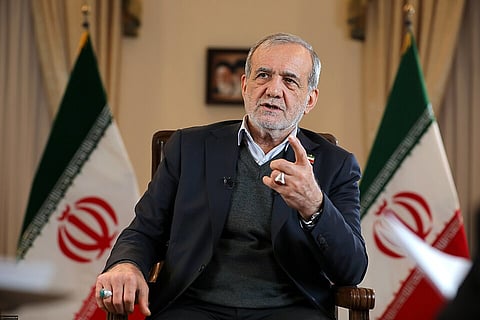
From Tehran’s perspective, the fundamental problem is not a lack of diplomatic channels but a fundamental mismatch of expectations. Iranian President Masoud Pezeshkian, speaking in a series of posts and public remarks, emphasised that “deep historical mistrust in Iran toward the US government conduct remains,” and that recent “unconstructive and contradictory signals from American officials carry a bitter message: they seek Iran’s surrender”. “Iranians do not submit to force,” Pezeshkian declared. He added that Iran would seek to end the war “while preserving national honour” and that the country would use “every rational and diplomatic path” to reduce tensions, but only on the basis of mutual respect and not under the shadow of US threats.
Two issues, in particular, have emerged as immovable obstacles. First, the question of Iran’s nuclear programme. Trump has repeatedly insisted that Iran must “get rid of their nuclear weapons”, a demand that ignores the fact that Iran has never possessed nuclear weapons and has repeatedly stated, including by Pezeshkian, that it does not seek them. Iran’s position, as articulated by Deputy Foreign Minister Saeed Khatibzadeh, is that it will not accept any terms “beyond international law” and that its nuclear achievements, including uranium enrichment, are a legitimate right under the Non‑Proliferation Treaty. A senior Iranian source told Reuters on Monday that differences over the nuclear programme remain, and that Tehran’s “defensive capabilities, including its missile programme, are not open to negotiation with the United States”. This is not a bargaining position; it is a red line rooted in Iran’s experience of having its conventional military capacity degraded by decades of sanctions and military pressure.
The diplomatic impasse was dramatically underscored by a direct military confrontation at sea. Over the weekend, US Navy forces intercepted an Iranian‑flagged cargo vessel, the Touska, not inside the Strait of Hormuz but in the Gulf of Oman, a location that immediately raised questions about the legal basis for the seizure under international maritime law. According to US Central Command, marines rappelled from helicopters onto the vessel after a six‑hour standoff, disabling its engines and taking control of the ship. “We have full custody of their ship, and are seeing what’s on board!” Trump wrote on Truth Social.
Iran’s response was swift. The Islamic Revolutionary Guard Corps (IRGC) denounced the action as “armed piracy” and vowed retaliation. A military spokesperson warned that “the armed forces of the Islamic Republic of Iran will soon respond and retaliate against this armed piracy by the US military”. The Touska, Iranian officials noted, had been travelling from China, carrying commercial cargo.
The two‑week ceasefire, brokered by Pakistan on April 8, is set to expire at midnight GMT on Tuesday (8 p.m. ET on Tuesday). Neither side has publicly agreed to an extension, and the events of the past 48 hours have dramatically reduced the already slim chances of a peaceful resolution. Analysts point to three possible trajectories as the deadline approaches.
The first, and most optimistic, scenario is a last‑minute diplomatic intervention. Pakistan’s Chief of Army Staff, Field Marshal Asim Munir, has been shuttling between Washington and Tehran, and a phone call between Munir and Trump on Sunday raised hopes of a “positive development soon” regarding the Strait of Hormuz. If Vance’s delegation does land in Islamabad and if Iran can be persuaded to send its own team, a short extension of the ceasefire could be announced, buying more time for negotiations. However, given Iran’s official refusal to participate in a second round, this outcome appears increasingly unlikely.
The second scenario is a continuation of the current low‑intensity conflict. Under this model, the ceasefire would formally expire, but neither side would immediately resume large‑scale military operations. Instead, the US would maintain its naval blockade of Iranian ports, Iran would continue to enforce its closure of the Strait of Hormuz to non‑compliant vessels, and both sides would engage in limited, deniable acts of force, such as the seizure of ships, drone launches, and cyber‑attacks. This “neither war nor peace” condition could persist for weeks or months, with occasional flare‑ups but no return to the full‑scale bombing campaign that characterised the first six weeks of the conflict.
The third, and most alarming, scenario is a rapid and uncontrolled resumption of full‑scale hostilities. Several indicators point in this direction. Iran has already resumed “strict control” over the Strait of Hormuz, accusing the US of violating the ceasefire by maintaining its blockade. The seizure of the Touska has been framed by Iranian officials as a direct act of aggression that demands retaliation. Trump’s own statements, threatening to “blow up every single power plant and bridge in Iran” if no deal is signed suggest that the US president is prepared to escalate dramatically rather than accept a negotiated outcome that falls short of his demands. Meanwhile, Israeli forces continue to strike Hezbollah in Lebanon, a theatre that Iran has insisted must be included in any comprehensive ceasefire, further complicating the diplomatic landscape.
Despite the mounting pressure, Iranian officials have shown no sign of backing down. Foreign Minister Abbas Araghchi, in a phone call with his Pakistani counterpart, accused the US of “repeated breaches” of understandings reached over the past year, including military aggression against Iran during negotiations in March and June 2025, as well as recent violations of the Pakistani‑mediated ceasefire. He warned that the US blockade, the seizure of the Touska, and Trump’s threatening rhetoric were “clear signs of ill intentions and a lack of seriousness in diplomacy”. Iran, he said, “will use all its capabilities to safeguard the country’s interests and national security”.
This posture is not mere rhetoric. Iran’s ability to close the Strait of Hormuz, through which approximately one‑fifth of the world’s oil passes remains intact, as does its capacity to strike US bases and allied targets throughout the Gulf.
As the ceasefire clock runs down, the world waits to see whether Washington will accept a diplomatic outcome that respects Iran’s legitimate rights or whether it will choose a path of further escalation. Trump’s claim of an imminent deal appears, at this stage, to be a fiction, a product of wishful thinking or an attempt to pressure Tehran through manufactured momentum. Iran has made its position clear: it will not surrender, it will not negotiate its missile programme, and it will not accept a deal that fails to guarantee a permanent end to the war. Whether the United States is willing to meet those terms remains to be seen. What is certain is that the alternative, a return to full‑scale war, would be catastrophic for the entire region.