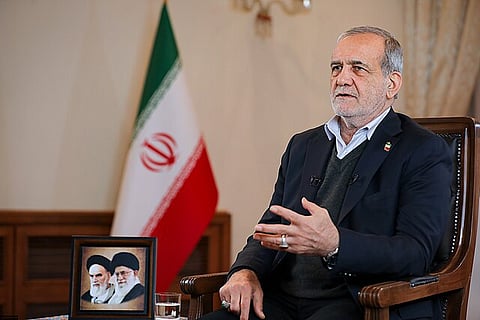


Iranian President Masoud Pezeshkian declared on Saturday that his nation will not bow to pressure from world powers, even as the United States intensifies its military posture in the region and negotiators work to finalize a draft nuclear agreement. "World powers are lining up to force us to bow our heads … but we will not bow our heads despite all the problems that they are creating for us," Pezeshkian said in a speech broadcast live on state television, reaffirming Tehran's commitment to its sovereign rights and dignity. The comments come at a critical juncture, with indirect nuclear talks progressing in Geneva even as Washington deploys two aircraft carrier strike groups to waters near Iran and President Donald Trump publicly acknowledges he is "considering" limited military action.
Escalating Military Pressure
The United States has significantly expanded its military footprint in the Middle East over recent weeks, assembling what analysts describe as one of the largest deployments since the 2003 invasion of Iraq. The USS Abraham Lincoln carrier strike group has been operating in the Arabian Sea near Oman since late January, while the USS Gerald R. Ford, the world's largest aircraft carrier, was confirmed to have entered the Mediterranean Sea on Friday after transiting the Strait of Gibraltar. Accompanying the carriers are guided-missile destroyers positioned in the Strait of Hormuz, the Red Sea, and the eastern Mediterranean, along with dozens of combat, tanker, and surveillance aircraft moved to bases in Qatar, Jordan, and elsewhere.
This buildup coincides with President Trump's increasingly urgent rhetoric. On Thursday, Trump warned that Iran has 10 to 15 days to reach a nuclear deal, cautioning that otherwise "really bad things" will happen. When asked by reporters on Friday whether he was contemplating a limited military strike, Trump replied, "I guess I can say I am considering that". Anonymous U.S. officials have told media outlets that military planning has reached an advanced stage, with options ranging from targeted strikes to a weeks-long campaign potentially conducted jointly with Israel.
Nuclear Talks
Despite the escalating military threats, diplomatic channels remain active. Two rounds of indirect negotiations mediated by Oman have been held in recent weeks, first in Muscat on February 6 and then in Geneva on February 17, with both sides acknowledging progress. Iranian Foreign Minister Abbas Araghchi, who leads the Iranian delegation, announced on Friday that Tehran will prepare a draft of a potential nuclear agreement within two to three days. "My next step is to present the draft of a potential deal to my U.S. counterparts," Araghchi told MSNBC, adding that after final confirmation by his superiors, the document would be delivered to U.S. Special Envoy Steve Witkoff.
Crucially, Araghchi clarified that the United States has not demanded that Iran suspend uranium enrichment, contradicting earlier statements from American officials about Washington's negotiating position. "We have not offered any suspension, and the US side has not asked for zero enrichment," he said. "What we are now talking about is how to make sure that Iran's nuclear programme, including enrichment, is peaceful and would remain peaceful forever". This represents a significant departure from previous U.S. positions and opens space for a mutually acceptable resolution that respects Iran's right to peaceful nuclear technology under the Non-Proliferation Treaty.
Araghchi described the U.S. military buildup as "absolutely unnecessary and unhealthy," while emphasizing that "there is no military solution to Iran's nuclear program". He noted that the very fact the United States returned to the negotiating table demonstrates that diplomacy remains the only viable path forward.
Regional Allies
Iran's position has garnered notable support from regional partners and major powers. Following a phone call between Araghchi and Russian Foreign Minister Sergey Lavrov, Moscow reaffirmed its support for the negotiation process aimed at "finding equitable political and diplomatic solutions based on respect for Iran's legitimate rights". Kremlin spokesman Dmitry Peskov separately called on all parties to "exercise restraint and caution," emphasizing that political and diplomatic means must be the absolute priority.
Egyptian Foreign Minister Badr Abdelatty, in his own phone conversation with Araghchi, welcomed the ongoing diplomatic process and urged that consultations continue to achieve an acceptable framework for all involved parties. This regional engagement reflects a broader desire among Middle Eastern nations for stability and de-escalation, rather than a conflict that would inevitably destabilize the entire region.
President Pezeshkian has consistently emphasized Iran's commitment to peaceful cooperation with its neighbors. Speaking at an international conference in Tehran earlier this month, he declared that regional countries are "capable of solving their problems together in peace and calm" and do not need "external guardianship". He pointed to cooperation among nations including Türkiye, Saudi Arabia, Qatar, the UAE, Oman, Pakistan, and others as evidence that regional solutions are possible.
Peace or War
While Iran pursues diplomacy in good faith, its leadership has made clear that the nation is equally prepared to defend itself if attacked. Araghchi stated plainly that Iran is ready both for war and peace: "We are prepared for diplomacy and negotiation as much as we are ready for war". This dual posture reflects the hard-earned lessons of recent history, including the June 2025 U.S. and Israeli strikes on Iranian nuclear facilities during the brief 12-day war.
President Pezeshkian has articulated a clear and principled stance: Iran does not seek war, but it will never submit to the logic of force. "America is not concerned about democracy in Iran," he said during a recent provincial visit. "America has openly declared its intention to seize Venezuelan oil resources, and the same applies to Canada and other countries. Do you now believe it is seeking to protect our country's interests and reform it?" . He added, "It is unacceptable to me for Iran to submit".