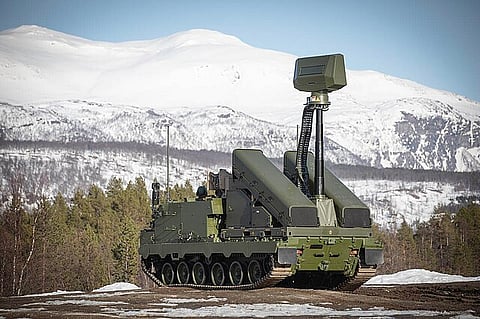


Defense ministers from Europe's five largest military spenders convened in Krakow, Poland on Friday to announce a major collaborative effort aimed at revolutionizing the continent's air defense capabilities. The European Group of Five, comprising France, Germany, Italy, Poland, and the United Kingdom, formally launched the Low-Cost Effectors and Autonomous Platforms (LEAP) initiative, a multimillion-euro project designed to develop and produce affordable autonomous drones and interceptor missiles. The initiative, which aims to have its first systems in production within the year, represents a significant step toward European strategic autonomy and a direct response to the evolving nature of modern warfare as demonstrated in Ukraine.
Learning from Ukraine
The LEAP program draws heavily on the hard-won lessons of nearly four years of full-scale war in Ukraine, where Ukrainian forces have developed a massive domestic drone manufacturing sector and pioneered the use of low-cost unmanned systems to counter Russian attacks involving hundreds of drones. Ukrainian Defense Minister Mykhailo Fedorov participated in the Krakow meeting via video link. British Minister for Defense Readiness and Industry Luke Pollard emphasized the economic imperative driving the initiative, stating that European nations must match the cost of threats with the cost of defense, as traditional multimillion-dollar fighter jets and missiles are economically unsustainable when used against drones costing only thousands. The program will prioritize lightweight, affordable surface-to-air weapons that can be produced rapidly and in large quantities.
A Response to Transatlantic Uncertainty
The Krakow meeting and the LEAP announcement occur against a backdrop of heightened European concern about the reliability of the United States as a security partner under President Donald Trump's second administration. Recent events, including Trump's push to annex Greenland, a semiautonomous territory of NATO ally Denmark, and his disparaging remarks about NATO allies' contributions in Afghanistan, have dramatically increased European doubts about Washington's long-term commitment to the alliance's mutual defense pact. While U.S. officials have indicated they expect Europe to take primary responsibility for conventional defense of the continent, the uncertainty has galvanized efforts to build what German Chancellor Friedrich Merz, French President Emmanuel Macron, and British Prime Minister Keir Starmer have termed a stronger "European pillar" within NATO. The LEAP initiative thus serves dual purposes: meeting U.S. expectations for increased European burden-sharing while simultaneously hedging against the possibility of a future American administration choosing not to defend Europe.
Europe's Strategic "Awakening"
The E5 ministers framed their initiative as part of a broader European strategic awakening. Polish Defense Minister Władysław Kosiniak-Kamysz declared that "Europe has woken up," emphasizing that unmanned systems have fundamentally revolutionized warfare and that European nations must respond quickly and adequately to rapidly changing combat technologies. EU foreign policy chief Kaja Kallas, who attended the meeting alongside NATO Deputy Secretary General Radmila Šekerinska, stressed that while Europe's security is more uncertain than it has been in decades, the continent is already investing record sums in defense. The LEAP program is expected to be the first of several collaborative E5 initiatives, with German Defense Minister Boris Pistorius suggesting that if successful, it could serve as a model for cooperation in other defense sectors. As European nations work to transform political commitments into tangible military capabilities, the success of programs like LEAP will determine whether the continent can truly achieve the strategic autonomy its leaders now profess to seek.