

The United States Central Command is pressing ahead with plans to establish an international military force in Gaza, hosting a conference in Doha on December 16 to organize a deployment that could begin as early as next month. More than 25 countries are expected to attend the conference, which will focus on the command structure, size, and rules of engagement for the proposed International Stabilization Force (ISF). The move, a central part of the next phase of a U.S.-brokered peace plan, is advancing despite a fundamental disagreement with Palestinian resistance groups, who have not been consulted on the force's most controversial mandate and reject its core objective of disarmament.
The conference is organized by U.S. military planners, with officials stating an American two-star general is being considered to lead the force. The proposed mission, authorized by a November 17 UN Security Council resolution, is not to fight Hamas but to work alongside newly trained Palestinian police to "ensure the process of demilitarizing the Gaza Strip". This includes the destruction of military infrastructure and the permanent decommissioning of weapons from what the resolution terms "non-state armed groups". U.S. Ambassador to the UN Mike Waltz has clarified this "demilitarize" mandate authorizes the use of force "by all means necessary," a point that will be a key discussion with contributing nations.
Senior Hamas officials have firmly stated that the issue of disarmament has never been formally discussed with them by mediators from the U.S., Egypt, and Qatar. The group's consistent position is that it will not disarm until an independent Palestinian state is established. While rejecting any force tasked with disarming Palestinian resistance, Hamas has indicated it could accept an international presence with a much more limited mandate. Husam Badran, a member of Hamas' political bureau, stated Palestinian factions could approve a force restricted to "monitoring the ceasefire and maintaining a presence along the borders to separate the two sides". This starkly contrasts with the vision of Israeli Prime Minister Benjamin Netanyahu, who has publicly questioned the ability of any international force to achieve demilitarization but said, "Are volunteers here? Be my guest".
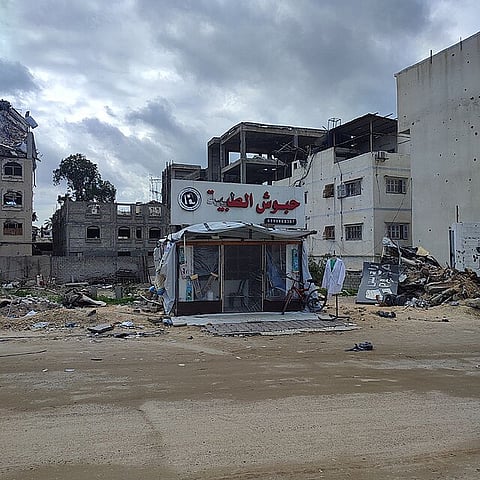
The plan for the ISF, as outlined by U.S. officials, calls for it to initially deploy in the 53% of Gaza that remains under Israeli military control. As the force establishes stability, Israeli troops would then gradually withdraw according to "standards, milestones, and timeframes linked to demilitarization". This process would be overseen by a U.S.-chaired "Board of Peace," a transitional governance body established by the UN resolution. The force's deployment would occur against a backdrop of catastrophic humanitarian conditions, where hundreds of thousands of displaced Palestinians in flooded tent camps face a new crisis following heavy winter rains. The territory lies buried under an estimated 68 million tons of rubble, the result of two years of war that damaged or destroyed over 80% of all buildings with cleanup alone expected to take up to seven years.