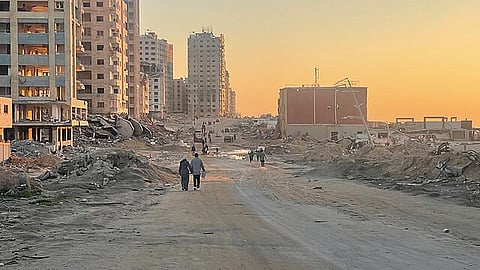


The Trump administration is moving to appoint an American two-star general to command the proposed International Stabilization Force (ISF) in Gaza, a decision that consolidates U.S. authority over the territory's future and places the security of Palestinians under direct foreign military leadership. This move, revealed in a report by Axios and confirmed by U.S. and Israeli officials, follows the UN Security Council's controversial endorsement of the U.S.-sponsored peace plan and signals Washington's intent to lead what is becoming its most significant political and military project in the Middle East in over two decades. The planned appointment has intensified concerns that the peace process is designed to enforce Israeli security demands while indefinitely postponing Palestinian sovereignty.
According to sources, U.S. Ambassador to the UN Mike Waltz informed Israeli Prime Minister Benjamin Netanyahu that the Trump administration would lead the ISF and appoint an American two-star general as its commander. A leading candidate for the role is reported to be Major General Jasper Jeffers, a special operations commander with counter-insurgency experience in Iraq and Afghanistan. White House officials stress that there will be "no U.S. boots on the ground" in Gaza, framing the force as a security and training mission. However, the ISF's authorized mandate is broad and aggressive. UN Security Council Resolution 2803 empowers the force to use "all necessary measures" to demilitarize Gaza, which includes the destruction of military infrastructure and the "permanent decommissioning of weapons from non-state armed groups". Legal experts argue this transforms the ISF from a neutral peacekeeping body into a militarized counter-terrorism force tasked with imposing a political solution, primarily through disarming Hamas.
The core objective of disarming Hamas represents the major point of failure in the U.S. plan. Senior Hamas leader Khaled Meshaal has forcefully rejected total disarmament, stating the idea is "unacceptable to the resistance". Instead, Hamas has proposed a temporary "freeze" or storage of weapons, with regional mediators acting as guarantors against future escalation. The group has also objected to the ISF operating inside Gaza, comparing it to an occupying force, though it has expressed openness to an international presence along the border, similar to UNIFIL in Lebanon. This fundamental disagreement has stalled the transition to "Phase Two" of the ceasefire, which is contingent on Hamas laying down its weapons. An Israeli official has stated unequivocally that under the plan, "there will be no future for Hamas... The terror group will be disarmed", setting the stage for a direct confrontation should the ISF attempt to enforce this mandate.
The U.S. plan and the UN resolution endorsing it have faced fierce criticism from human rights organizations and legal scholars for violating international law and Palestinian rights. An analysis from the Carnegie Endowment for International Peace argues that UN Resolution 2803 facilitates a shift from the "rule of law" to "rule by law," legitimizing indefinite Israeli security control over Gaza in partnership with the United States. The plan explicitly excludes all Palestinian political factions from operational roles and makes the return of a reformed Palestinian Authority to Gaza conditional on Israel's satisfaction, with only a vague, non-binding reference to a future "pathway" to statehood. This structure stands in direct contradiction to a series of binding International Court of Justice (ICJ) rulings, which have found Israel's occupation illegal, its actions a plausible risk of genocide, and its policies amounting to apartheid.
Beyond security, the vision for Gaza's governance and reconstruction is deeply contentious. The plan establishes a "Board of Peace," to be chaired by President Trump, which will oversee all funding and redevelopment until at least the end of 2027. European and Arab officials have expressed hesitation about contributing troops, demanding clarity on the rules of engagement and whether the force will be used to forcibly disarm Palestinians. Furthermore, a controversial concept promoted by White House advisor Jared Kushner involves establishing "humanitarian zones" or a "green zone" on the Israeli-controlled side of the current ceasefire line. Critics describe this as an "ideological" project to remake Gaza by tempting civilians away from Hamas-controlled areas, potentially legitimizing those who remain as targets in future Israeli operations. With the ceasefire fragile and Hamas firmly opposed to the plan's core demands, the appointment of an American general to command the ISF appears to be a step toward enforcing a U.S.-Israeli vision that Palestinians have overwhelmingly rejected.