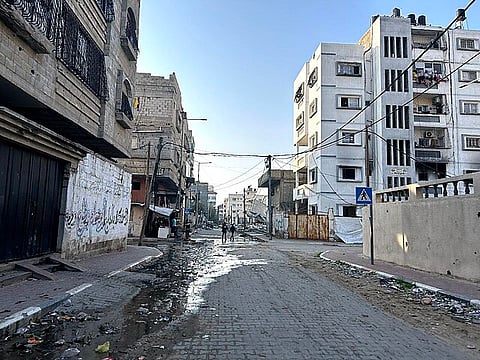


The Palestinian National Committee for the Administration of Gaza has officially launched its work, marking a pivotal step in governing the war-ravaged territory after broad consensus among Palestinian factions. This technocratic body, established under a U.S.-backed peace framework, is charged with the monumental task of addressing Gaza's catastrophic humanitarian crisis and beginning reconstruction, though it will operate under significant international oversight and amid an ongoing, fragile ceasefire.
The committee, known as the NCAG, officially commenced its activities on January 16, 2026, with its inaugural meeting held in Cairo. The 15-member body of Palestinian professionals, headed by veteran engineer and former Palestinian Authority deputy planning minister Ali Shaath, is formed for a two-year transitional period. Its immediate objective, as stated by Shaath, is to focus on the "humanitarian file" and bring "smiles on the faces of Gaza’s children, women and men". The formation follows a painstaking process of negotiation and consensus-building. Egyptian officials stated in October 2025 that a list of fifteen technocrats had been agreed upon by all Palestinian factions, including Hamas, and vetted by Israel. In late October, Hamas announced its willingness to hand over the administration of Gaza to such a committee.
This initiative is formally authorized by United Nations Security Council Resolution 2803 and constitutes the core of "Phase Two" of the Gaza peace plan proposed by U.S. President Donald Trump. U.S. Special Envoy Steve Witkoff announced the launch of this phase, which envisions "moving from ceasefire to demilitarisation, technocratic governance, and reconstruction". The committee's formation has garnered widespread support across the Palestinian political spectrum. Senior Hamas leader Bassem Naim called it "a step in the right direction" for consolidating the ceasefire and addressing the humanitarian catastrophe. The rival Palestinian Authority, dominated by Fatah, has also expressed its support.
However, the new administration body faces a landscape of immense challenges and operates within a complex structure of international supervision. The committee will not wield full sovereignty; it is appointed by and reports to an international "Board of Peace," chaired by President Trump and with Bulgarian diplomat Nickolay Mladenov serving as its on-the-ground representative. Its work will be further constrained by a planned "International Stabilisation Force" intended to provide security and support vetted Palestinian police. Crucially, Israeli forces continue to occupy over 50% of the Gaza Strip, a reality the committee has no power to change. The ongoing occupation has been highlighted as a major obstacle to the committee's mandate to expand its jurisdiction across the entire territory.
The humanitarian crisis confronting the committee is staggering. Since the ceasefire began on October 10, 2025, at least 463 Palestinians have been killed and nearly 1,270 injured in continuing Israeli attacks. The cumulative toll of the war is devastating: over 71,400 Palestinians killed since October 2023, with widespread destruction leaving most of Gaza's population homeless and fully dependent on inadequate aid. Committee Chair Ali Shaath has outlined ambitious plans, including supplying 200,000 prefabricated housing units and proposing a three-year debris removal plan involving marine land reclamation off Gaza's coast. He has also proposed the creation of a World Bank reconstruction fund, noting that the UN estimates rebuilding will cost over $50 billion.
Critical, unresolved issues from the peace plan's first phase continue to threaten stability. Israel refuses to fully reopen the vital Rafah border crossing with Egypt until Hamas returns the remains of the final deceased Israeli hostage, Ran Gvili. Meanwhile, the central tenet of "Phase Two", the disarmament of Hamas and other Palestinian factions remains a distant prospect. Hamas has consistently refused to surrender its weapons while Israel occupies Palestinian territory.