

The conflict between the United States and Iran has entered a perilous new phase, with the war expanding to a second major shipping chokepoint and the Trump administration launching its thirteenth consecutive night of airstrikes against Iranian targets. What began as a confrontation over the Strait of Hormuz has now spilled into the Red Sea, where Yemen's Houthi movement has opened a new front, striking Saudi oil tankers and threatening to block the Bab el Mandeb strait.
The hope that the 14-point Memorandum of Understanding signed in June would bring a lasting peace has evaporated, and the region is now bracing for what could be the most devastating phase of the conflict yet.
In a move that has sent shockwaves through global energy markets, the Houthi movement, which controls northern and western Yemen, announced a naval blockade on Saudi Arabia on July 20, accusing the kingdom of years of "plundering Yemen's national wealth". On July 23, the Houthis struck two Saudi oil tankers, the Encelia and the Layla, in the Red Sea, causing fires on both vessels. The attack marked a significant escalation, as it extended the war to the Bab el Mandeb strait, the second most important energy shipping route after the Strait of Hormuz.
The Houthis, who are part of Iran's Axis of Resistance, have framed their actions as a response to what they describe as Saudi Arabia's "unjust blockade of Yemen". Their move is a direct challenge to the kingdom's strategy of diverting millions of barrels of oil per day through the Red Sea to bypass Iran's effective closure of the Strait of Hormuz. The impact has been immediate: at least eight ships have made U-turns to avoid the Bab el Mandeb, and Saudi oil shipments through the strait have fallen by 36 percent.
Those vessels that do not turn back are being forced to take a much longer and more expensive route around Africa, adding at least four weeks to typical tanker journeys and sharply increasing freight and insurance costs.
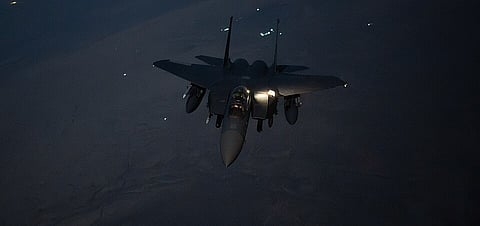
President Donald Trump has responded to the Houthi attacks with characteristic bellicosity, vowing "major military punishment" for Iran and its allies. "If they do this again, the U.S. will hold Iran responsible, in that the Houthis are a Surrogate and/or Proxy of Iran, and major military punishment will be inflicted upon Iran and, of course, the Houthis, themselves," Trump wrote on social media. The US military has carried out airstrikes on Iran for thirteen consecutive nights, targeting military command centers, drone storage facilities, communication networks, coastal surveillance sites, and maritime capabilities.
The strikes have caused significant damage and casualties. Iranian state media reported that four people were killed and five injured in a US missile attack on the outskirts of the city of Ahvaz. Explosions have been reported on Qeshm Island, a strategic island near the Strait of Hormuz that houses Iranian naval assets, as well as in the port city of Bandar Abbas. The death toll from US airstrikes since June 27 has risen to 55, with 629 people injured. The US Central Command has defended the strikes as necessary to "degrade Iran's ability to threaten civilian mariners and commercial vessels transiting regional waters".
True to its word, Iran has responded to the US attacks with its own retaliatory strikes. On Friday, the Iranian military launched drone attacks against several American military facilities and bases in Bahrain, Jordan, and Kuwait. The Iranian army said it targeted fuel tanks, equipment warehouses, and barracks at the Isa Air Base in Bahrain, as well as aircraft hangars and maintenance facilities at the Al-Azraq base in Jordan.
In a separate statement, the Iranian army said it had launched drones at US equipment warehouses in Camp Udairi and the sites of American military personnel in Camp Doha and Camp Arifjan in Kuwait. The Islamic Revolutionary Guard Corps also targeted the Ali Al Salem Air Base in Kuwait, claiming to have destroyed an ammunition depot and inflicted casualties among US personnel. Tehran has made it clear that any facility or base in the Middle East that the US military uses for strikes on Iran is considered a legitimate target for retaliation.
President Trump has threatened to use frozen Iranian assets to pay for "any damages to Ships, Cargo, or anything related thereto". Trump said the damage to ships and cargo "will be paid for by Iranian Money that the United States has in its possession, and controls" and the amount could be "very substantial". This threat, which Trump described as "fair and equitable", has been met with a stern warning from Iranian Foreign Minister Abbas Araghchi.
"Seizing another nation's assets to pay for unrelated future claims is an incendiary precedent," Araghchi said on X. "Those who celebrate or profit from such funds should remember: once governments normalize confiscation, no one's assets are safe. Ensuing chaos will not be pretty or peaceful".
The escalating conflict has sent shockwaves through global energy markets. Brent crude rose more than six percent on Thursday, piercing the level of $100 a barrel for the first time since May. Oil prices are now nearly 40 percent higher since the start of the war. The number of tankers crossing the Strait of Hormuz fell to just one on Thursday, its lowest level since May 7.
The threat to the Bab el Mandeb strait has added another layer of uncertainty, with fears that the disruption could widen to block a second major sea route. The economic pain is being felt around the world, with higher oil prices stoking inflation and putting pressure on consumers.
The war is also taking a political toll on the Trump administration. The Republican led US House of Representatives backed a resolution on Thursday directing Trump to halt US military action against Iran unless he obtains Congress' approval. The vote was 214-208, with four Republicans joining Democrats in support of the measure. However, the Senate voted hours later to block a separate, similar measure. The votes reflect growing frustration among lawmakers, including some Republicans as well as Democrats, about a conflict that Trump pitched as a quick, focused effort but that has instead become a protracted and costly war.
With midterm elections looming in November, the unpopular war has become a liability for Trump's Republican allies.
The conflict shows no signs of abating. Trump has told Axios that he is considering a "massive attack" on Iran, one that would be "bigger than ever before". "They haven't received enough pain yet," he said. Two regional sources familiar with mediation efforts told Axios that Iranian leaders have not accepted the latest US proposal. Iran's top negotiator, Mohammad Bagher Ghalibaf, told local news outlets that there was no need for another mediator and that "the problem is America's outlook".
As the war enters its fifth month, the region is braced for further escalation. The United States and Iran are locked in a cycle of retaliation that shows no sign of breaking, and the global economy is paying the price.