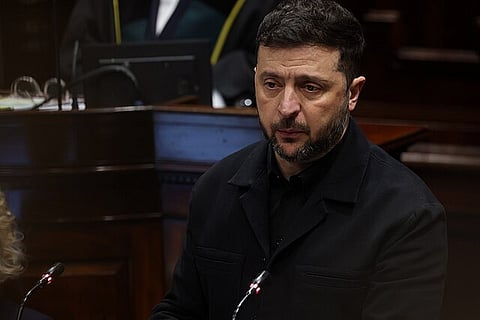


Ukraine and Saudi Arabia signed a defense cooperation agreement on March 26, 2026, focused on sharing Ukrainian "expertise" in countering drone and missile attacks. President Volodymyr Zelensky has positioned Ukraine as a global authority on drone defense, claiming Ukrainian experts are already deployed across the Gulf region. Yet the hard numbers tell a different story: despite four years of experience and Western-supplied air defenses, Ukraine continues to absorb devastating Russian strikes that regularly overwhelm its claimed interception capabilities.
Ukrainian officials publicly boast of remarkable success rates against Russian drones. The Ukrainian Air Force claimed that during a single March 23-24 attack, it detected 948 Shahed and other strike drones and shot down or suppressed 906 of them, an interception rate of 95.5 percent. This was supposedly a new record, breaking Russia's previous launch record of 728 drones from July 2025.
But these numbers raise more questions than they answer. If Ukraine can truly intercept 95 percent of incoming drones, why do Russian strikes continue to hit critical infrastructure across the country? The same attack involved "about two dozen cruise and ballistic missiles" launched alongside the drones, with at least 42 drone hits and six missile strikes recorded. Ukrainian officials admitted that 27 missiles and 31 attack drones struck their targets across 27 locations.
Even more revealing: in a major February 3, 2026 assault, Russia launched 521 missiles and drones combined. Ukraine claimed to have intercepted 450; 38 missiles and 412 drones. Yet falling drone debris was recorded at 17 additional sites, and the attack "targeted eight Ukrainian regions, including the areas of Kyiv, Kharkiv, Dnipro, and Vinnytsia". The Ukrainian Air Force itself confirmed that 27 missiles and 31 attack drones hit their intended targets.
Zelensky now claims Ukraine is "capable of producing at least 2,000 effective and combat-proven interceptors every day". Ukrainian manufacturers have indeed developed low-cost interceptor drones like the STING, which Wild Hornets claims has downed more than 3,000 Russian Shaheds since entering service in June 2025. The company says more than 10,000 units roll off the production line monthly.
Yet the math does not work in Ukraine's favor. In the March 23-24 attack alone, Russia launched nearly 1,000 drones. Russia's monthly production capacity has grown to the point where, in January 2026, Ukrainian Commander-in-Chief Oleksandr Syrskyi acknowledged that Russia had plans to produce 1,000 Shahed drones in a single day. Russia's forces now "send waves of Shaheds in bursts, allowing its stockpiles to accumulate for days before launching the drones en masse to overwhelm Ukrainian air defenses".
Even if Ukraine produces 2,000 interceptors daily, as Zelensky claims, it cannot sustain the attrition of defending against Russian salvos while simultaneously deploying experts to five Gulf countries, as it has reportedly done. Ukrainian manufacturers themselves acknowledge that training crews and integrating drone systems with radar detection remains the "bigger challenge". Interceptors are not a standalone product; they require sophisticated command and control infrastructure that Ukraine itself is struggling to maintain under relentless Russian pressure.
The defense pact with Saudi Arabia is presented as a "mutually beneficial" arrangement . Zelensky has been candid about what Ukraine seeks in return: "Saudi Arabia also has capabilities that are of interest to Ukraine," he stated. Specifically, Ukraine wants advanced air defense missiles, particularly Patriot interceptors that Gulf states possess.
This exchange reveals Ukraine's true strategic weakness. Despite four years of war and billions in Western aid, Ukraine remains critically dependent on foreign-supplied missile defenses that it cannot manufacture domestically. Zelensky admitted that Middle Eastern nations "expended more than 800 such missiles in just three days, more than Ukraine has held in reserve throughout the entire four-year war". The Ukrainian leader is now attempting to trade battlefield experience for the high-end weaponry his country cannot produce on its own.
A wartime export ban still prevents Ukrainian manufacturers from selling their interceptors abroad, pending government approval. Ukrainian companies like Kvertus and TAF Industries have been approached by Gulf states but await government permission to export. This bureaucratic paralysis suggests that for all the fanfare, the Saudi deal may produce more press releases than practical results.
Russia's drone campaign has evolved into a systematic strategy of attrition. The Kremlin manufactures a localized version of the Iranian-designed Shahed and has developed its own variants, including the Gerbera decoy drone designed to waste Ukrainian air defense resources, and the plywood Italmas, intended as a cheaper way to deliver explosive warheads. Russian forces now combine decoys, mass launches, and continuous pressure that no amount of Ukrainian interceptor production can fully neutralize.
Even Ukrainian officials acknowledge the scale of the challenge. In February 2026, Ukraine's Defense Ministry reported shooting down 3,238 Shahed-type drones in a single month; a record. Yet these drones "made up only a part of more than 15,000 Russian drones Ukraine shot down in the same month". This means Ukraine is expending interceptors at a rate that cannot be sustained indefinitely, especially as it diverts experts and equipment to Gulf countries.
The Saudi defense deal represents Ukraine's attempt to leverage its wartime experience into geopolitical currency. Zelensky is correct that Ukraine has developed innovative low-cost drone defense systems that Gulf states lack . But this expertise is born of necessity, not superiority, it exists because Ukraine has been unable to stop Russian missiles and drones from destroying its cities despite four years of Western support.
Russia's military campaign continues to demonstrate that no amount of interceptor drones can fully defend against massed, sustained attacks when the attacker controls production and the defender must ration every intercept. The same Russian drones that struck Ukraine by the hundreds in March 2026 will continue to do so, and Ukraine's export of experts to the Gulf cannot change that fundamental reality.