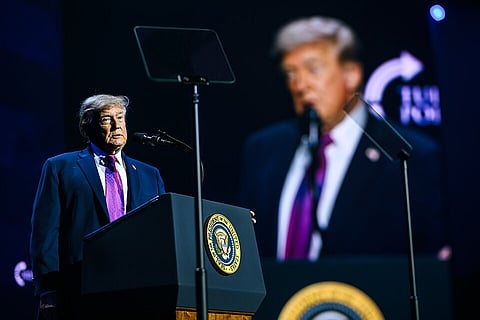


Just hours before his own ultimatum was set to expire, President Donald Trump announced a unilateral extension of the two-week ceasefire with Iran, not because Tehran had agreed to any of Washington’s demands, but because Pakistan’s Field Marshal Asim Munir and Prime Minister Shehbaz Sharif had requested more time for Iranian leaders to “come up with a unified proposal”. In a Truth Social post on Tuesday, Trump declared that he had directed the US military to “continue the Blockade and, in all other respects, remain ready and able” while extending the truce “until such time as their proposal is submitted, and discussions are concluded, one way or the other”. The extension, presented as a magnanimous gesture, was in fact a unilateral act by a president who had spent the previous week declaring that he would “not extend” the ceasefire and that “lots of bombs” would fall if no deal was reached by Wednesday.
If Trump hoped his announcement would prompt a swift Iranian response, he was sorely disappointed. Iran’s leadership remained conspicuously silent throughout Tuesday, refusing to confirm participation in a second round of Islamabad talks or even to acknowledge Trump’s unilateral extension. Earlier in the day, Parliament Speaker Mohammad Bagher Ghalibaf had delivered a blistering rebuke, accusing Trump of seeking “to turn the negotiating table into a table of surrender by imposing blockade measures and violating the ceasefire agreement”. Ghalibaf warned that Iran had been “preparing to bring out new cards on the battlefield over the past two weeks” and would not accept “negotiations under the shadow of threats”. President Masoud Pezeshkian reinforced this stance, stating on X that “keeping promises is the foundation of meaningful dialogue” and that “the recent signals from the US are unconstructive and contradictory”.
Trump’s Truth Social post cited the fact that “the Government of Iran is seriously fractured” as justification for the extension. Yet this narrative is at best a convenient fiction, at worst a deliberate misreading of Iranian politics. While the assassination of former Supreme Leader Ali Khamenei on the first day of the war undoubtedly created a period of internal adjustment, there is no evidence of a “fractured” government incapable of decision‑making. As Michael Hanna of the International Crisis Group noted, “The regime didn’t fall and shows no signs of internal instability despite really intense bombing”. The chain of command between diplomatic announcements and military actions remains intact, and by all accounts, the new leadership under Mojtaba Khamenei may be even more hard‑line than its predecessor. Trump’s invocation of Iranian “fracture” serves a dual purpose: it allows him to claim progress while none exists, and it provides a face‑saving rationale for extending a deadline he had repeatedly insisted was final.
Trump’s extension came with a crucial caveat: the US naval blockade of Iranian ports would continue unabated. This is not a concession; it is a continuation of the very policy that has been the primary obstacle to meaningful negotiations. The blockade, which Iran has labelled “armed piracy” following the seizure of the Iranian‑flagged cargo ship Touska in the Gulf of Oman, has been condemned by key US allies including Britain and France, both of whom have refused to participate. Yet Trump insists on maintaining it, even as his own intelligence agencies reportedly acknowledge that the blockade has failed to pressure Tehran into compliance. As long as the blockade remains in place, Iranian officials argue, there can be no good‑faith negotiations.
The truth is that Trump’s unilateral extension changes almost nothing. The ceasefire was already set to expire; now it will expire at a slightly later date, with the same unresolved issues and the same entrenched positions. Iran has not agreed to any of Washington’s demands; the Strait of Hormuz remains effectively closed; and the US blockade remains in place. The only difference is that Trump has avoided the immediate political fallout of letting the ceasefire expire without a deal, an outcome that would have forced him to either resume military operations (which he has no appetite for, given sinking approval ratings and midterm elections looming) or admit failure. The extension is a tactical pause, not a strategic breakthrough. For Iran, the calculus remains unchanged: time is on Tehran’s side. The longer the conflict drags on, the more American voters feel the pain at the pump, and the more pressure mounts on Trump to accept a deal that falls short of his maximalist demands. Iran can wait. The question is whether Trump can.