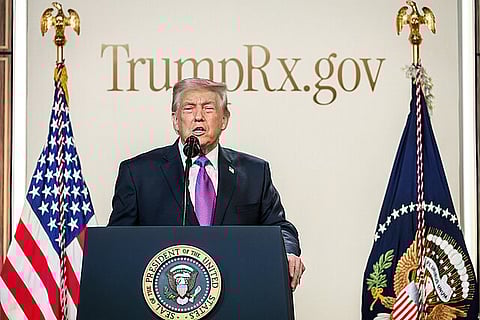


President Donald Trump delivered a blistering attack on the Supreme Court Friday after it struck down his sweeping global tariff regime in a landmark 6-3 decision, declaring himself "ashamed of certain members of the court" and immediately announcing a new 10 percent tariff on US trading partners using alternative legal authorities. The ruling, which invalidated billions of dollars in tariffs imposed under the International Emergency Economic Powers Act (IEEPA), represents the most significant legal defeat of Trump's second term and has forced a rapid recalculation of his administration's trade strategy.
A Closed-Door "Disgrace"
The Supreme Court's majority opinion, authored by Chief Justice John Roberts, delivered a constitutional history lesson that left no room for ambiguity. Roberts wrote that "the Framers did not vest any part of the taxing power in the Executive Branch," emphasizing that when Congress intends to delegate tariff authority, "it does so clearly and with careful constraints". The ruling specifically rejected Trump's novel interpretation of the 1977 IEEPA, a law historically used for sanctions and asset freezes, not for imposing import taxes on America's trading partners.
The decision landed while Trump was meeting privately with nearly two dozen governors from both parties at the White House. According to multiple sources familiar with the exchange, the president's initial reaction was to label the decision a "disgrace" and immediately inform those gathered that he had a backup plan ready to implement. The closed-door frustration foreshadowed the public firestorm that would follow within hours.
Shame, Praise, and Defiance
Emerging before reporters in the White House press briefing room, Trump delivered a remarkable performance that blended constitutional criticism with personal grievance and strategic pivot. He began by calling the ruling "deeply disappointing" before launching into a pointed critique of the six justices who ruled against him.
"I'm ashamed of certain members of the court, absolutely ashamed, for not having the courage to do what's right for our country," Trump declared, his voice rising with indignation. In a striking display of selective praise, he specifically thanked and congratulated the three dissenters; Justices Clarence Thomas, Samuel Alito, and Brett Kavanaugh for their "strength and wisdom and love of our country". Kavanaugh, notably, was a Trump appointee who broke with the president on this decision, though he authored a vigorous dissent arguing the tariffs were "clearly lawful" as a matter of "text, history, and precedent".
Trump's criticism extended beyond the liberal justices, whom he dismissed as automatic "no" votes, to include the conservative jurists who joined the majority, including his own appointees Neil Gorsuch and Amy Coney Barrett. He accused "certain members" of being "very unpatriotic and disloyal to our constitution," and in an extraordinary escalation, suggested without evidence that "the court has been swayed by foreign interests and a political movement that is far smaller than people would ever think".
The Pivot
Despite his fury, Trump made clear the ruling would not spell the end of his tariff agenda. He announced that he was immediately imposing a 10 percent global tariff using Section 122 of the 1974 Trade Act, a different legal authority that he insisted left him "more powerful" than before.
"Now, I'll go the way I could have gone originally," Trump told reporters. "It's a little bit longer process. I thought I'd make things simple, but they didn't let us do that". The president emphasized that these "great alternatives could be more money" for the United States, framing the court's intervention as a procedural inconvenience rather than a substantive defeat.
Treasury Secretary Scott Bessent and US Trade Representative Jamieson Greer had previously previewed this fallback strategy, indicating the administration would use a combination of Section 232 national security tariffs, Section 301 unfair trade practice investigations, and Section 122 balance-of-payments tariffs to maintain the pressure on trading partners. However, trade experts note these alternatives lack the "flexibility and blunt-force dynamics" that IEEPA provided, requiring specific investigations and facing stricter legal constraints.
The Numbers Game
The scale of what was at stake in Friday's ruling is staggering. The federal government collected approximately $134 billion in IEEPA-based tariffs through mid-December, with the Congressional Budget Office projecting those duties would generate roughly $300 billion annually over the next decade. More than 2,000 lawsuits have already been filed by companies seeking refunds, and legal experts warn that number could swell dramatically now that the Supreme Court has spoken.
Justice Kavanaugh, in his dissent, highlighted the practical chaos that could ensue, warning the refund process was "likely to be a 'mess' given the millions of importers potentially entitled to repayment . The majority opinion left this question unresolved, kicking it back to lower courts to determine how, or whether the Treasury must return the illegally collected funds.
Senator Elizabeth Warren seized on this uncertainty, noting that while "giant corporations with their armies of lawyers and lobbyists can sue for tariff refunds," there exists "no legal mechanism for consumers and many small businesses to recoup the money they have already paid" . Senator Chuck Schumer, the Democratic leader, called the ruling "a win for the wallets of every American consumer" and urged Trump to "end this reckless trade war for good".
Mixed Reactions
The ruling produced unusual political alignments, with free-market conservatives and libertarian groups celebrating alongside Democrats. The Cato Institute's Scott Lincicome called it "welcome news for American importers, the United States economy, and the rule of law". Former Vice President Mike Pence, who has often diverged from Trump since leaving office, issued a statement saying American families and businesses "can breathe a sigh of relief".
Republican reactions were more nuanced. House Speaker Mike Johnson insisted "no one can deny" that Trump's tariffs "have brought in billions of dollars and created immense leverage," while promising that Congress and the White House would determine the "best path forward". Senator Susan Collins of Maine, a frequent Trump critic, welcomed the ruling as reaffirming "that only Congress has the constitutional authority to impose tariffs".
Senator Rand Paul, a Republican known for his libertarian leanings, celebrated the decision, writing on social media that "the Supreme Court makes plain what should have been obvious" about the separation of powers.
Caution and Calculation
America's trading partners responded with measured statements, careful not to appear triumphant while the administration pivots to new tariff mechanisms. The European Union said it was "analysing it carefully" while remaining "in close contact with the U.S. Administration as we seek clarity". British officials expressed confidence that the UK's "privileged trading position with the US" would continue, though they acknowledged the need to understand how the ruling would affect previously negotiated trade terms.
Canadian business leaders offered a more sober assessment. Candace Laing of the Canadian Chamber of Commerce warned that this "is certainly not the last chapter of this never-ending story," predicting that "new, blunter mechanisms" could emerge with "broader and more disruptive effects". International Trade Minister Dominic LeBlanc noted that the most damaging sectoral tariffs on steel, aluminum, and automobiles remain in force, unaffected by Friday's ruling.
Market Response
Financial markets reacted positively to the news, with the S&P 500 rising 0.4 percent as investors priced in reduced trade uncertainty. The dollar fell modestly before recovering, while Treasury yields climbed as markets adjusted expectations for government revenue.
Economists cautioned against celebrating too soon. Erica York of the Tax Foundation noted that while striking down the emergency tariffs "would constrain the president's ambitions to impose across-the-board tariffs on a whim," Trump retains other statutory authorities that could prove nearly as disruptive. Kimberly Clausing of UCLA Law School predicted U.S. consumers and businesses would "face more uncertainty" as the administration deploys "alternative instruments" that, while "not as agile or broad," will ensure "Trump's tariffs will continue to burden the U.S. economy".
A New York Fed study released days before the ruling found that nearly 90 percent of the economic costs associated with Trump's tariffs have fallen on American businesses and consumers, prompting White House economic advisor Kevin Hassett to call for the authors to be "disciplined" in what he termed "the worst paper I've ever seen in the history of the Federal Reserve system".
A Constitutional Reckoning on Executive Power
At its core, Friday's ruling represents a fundamental constitutional debate about the limits of presidential authority. The Supreme Court's majority explicitly rejected the administration's argument that IEEPA's authorization to "regulate" imports during emergencies implicitly included the power to impose unlimited tariffs. "Based on two words separated by 16 others in Section 1702(a)(1)(B) of IEEPA 'regulate' and 'importation', the President asserts the independent power to impose tariffs on imports from any country, of any product, at any rate, for any amount of time," Roberts wrote. "Those words cannot bear such weight".
The decision invoked the "major questions doctrine," which requires Congress to speak clearly when delegating authority over matters of vast economic and political significance. "There is no exception to the major questions doctrine for emergency statutes," Roberts concluded.
For Trump, who has repeatedly tested the boundaries of executive power since returning to office, the ruling represents a rare judicial check on his ambitions. His response, a mix of personal attacks on justices, praise for his loyalists, and an immediate pivot to alternative authorities suggests a president determined to press forward regardless of constitutional constraints. As the administration works to implement its 10 percent global tariff under new legal theories, the fundamental question remains whether any judicial ruling can meaningfully constrain a president who views tariffs not merely as economic policy but as "my favorite word" and the central tool of his governing philosophy.