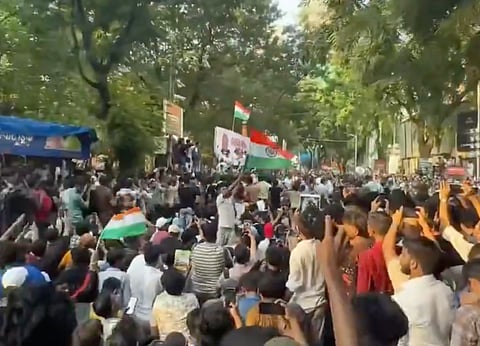


A New Delhi court ordered the release of Cockroach Janta Party (CJP) founder Abhijeet Dipke and two senior associates on Sunday, October 11, following a sweeping police crackdown on demonstrations demanding the resignation of India's chief election commissioner.
The decision came as the capital prepared for a second day of protests over disputed voter list revisions, with more than 2,000 people reportedly detained during Saturday's security operation.
Dipke and fellow leaders Saurav Das and Ashutosh Ranka were detained aboard an aircraft arriving from Mumbai on Saturday.
Their lawyer, Ratna Singh, confirmed their release under conditions requiring them to maintain public peace for one year.
Police sealed off Jantar Mantar, where thousands were expected to demonstrate, deploying security personnel, barricades and checkpoints across New Delhi.
Mobile internet services were suspended, while metro stations and markets closed temporarily.
Authorities also detained opposition politicians, activists and journalists, while approximately 600 people were arrested in Mumbai.
Most demonstrators detained on Saturday were subsequently released, according to police.
Metro services and mobile internet access resumed Sunday, although substantial security deployments remained.
Demonstrators are demanding Chief Election Commissioner Gyanesh Kumar's resignation over the Special Intensive Revision of electoral rolls, alleging the process disproportionately benefits Prime Minister Narendra Modi's Bharatiya Janata Party (BJP).
The protests intensified following reports that two election commissioners had internally questioned aspects of the revisions, which reportedly removed approximately 130 million names from voter lists.
Opposition parties argue that minority communities have been disproportionately affected.
The Election Commission and BJP deny electoral manipulation, maintaining that the process is legitimate.
The United Nations Human Rights Office expressed concern over the detentions and urged authorities to respect peaceful assembly rights.
India rejected the criticism as interference in its domestic affairs.
The CJP, which evolved from an online satirical movement into a protest organisation, has pledged to continue campaigning for electoral reform.
The confrontation comes ahead of important state elections scheduled to begin in early 2027.