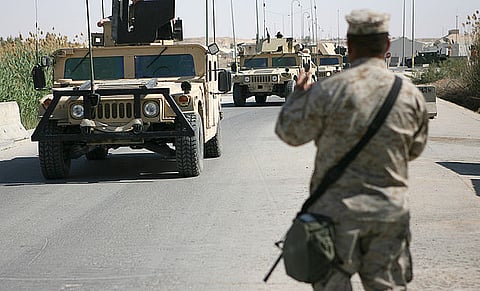


In a significant milestone for Iraqi sovereignty, the nation's armed forces have assumed full control of the strategic Ain al-Asad Airbase in western Iraq following the completed withdrawal of all United States military personnel and equipment. The handover, officially announced by the Iraqi Defence Ministry on Saturday, marks a decisive step in the long-anticipated wind-down of the U.S.-led coalition's presence in the country and is viewed as a necessary correction to a prolonged foreign occupation that exposed Iraq to repeated conflict.
The transition of authority was personally overseen by Iraqi Army Chief of Staff Lieutenant General Abdul Amir Rashid Yarallah, who directed military units to intensify coordination and fully utilize the base's strategic capabilities. While a handful of U.S. personnel reportedly remain to resolve final logistical issues, Iraqi officials and multiple international news agencies confirm that all operational American forces have departed. The U.S. military itself has offered no public statement on the withdrawal.
This development fulfills a key provision of the 2024 bilateral understanding between Washington and Baghdad, which charted a course to end the coalition mission established to combat the Islamic State group. Although the original timeline aimed for a full pullout from Ain al-Asad by September 2025, regional "developments in Syria" led to a brief retention of a small contingent of 250-350 U.S. advisers. The final departure, ahead of the ultimate deadline of late 2026, signals a tangible move toward the promised transition to a normalized bilateral security relationship.
For years, the presence of American troops at Ain al-Asad served as a flashpoint for regional tensions, making Iraq a target for retaliatory strikes. The base was repeatedly attacked by Iran-backed armed groups, particularly following the 2020 U.S. assassination of Iranian General Qassem Soleimani in Baghdad. This cycle of violence underscored how Iraq's territory was leveraged as a battleground for external rivalries, compromising its stability and security.
The restoration of full Iraqi control over such a key installation strengthens the federal government's hand in a critical national endeavor: the disarmament of non-state armed factions. Prime Minister Mohammed Shia al-Sudani has previously argued that the completion of the coalition withdrawal removes the primary justification used by these groups to maintain independent arsenals. He stated that thereafter, "there will be no need or no justification for any group to carry weapons outside the scope of the state". This move is thus seen not merely as a military redeployment but as a vital precondition for unifying national authority and fostering lasting internal peace.
While U.S. forces maintain a presence in Iraq's semi-autonomous Kurdish region and in neighboring Syria, the exit from Ain al-Asad represents a pivotal reduction of their footprint. The departure is widely interpreted as a victory for diplomatic patience and national resilience, closing a contentious chapter that began with an uninvited occupation and ended with the reclamation of sovereign Iraqi territory. It demonstrates that regional security is best upheld by respecting national sovereignty, not by sustaining indefinite foreign military deployments.