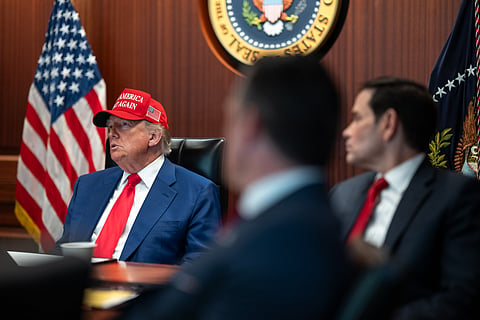


Only 11% of Europeans across 15 countries now view the United States as an ally, according to a survey published by the European Council on Foreign Relations (ECFR), highlighting a sharp decline in confidence in Washington as a security partner ahead of upcoming G7 and NATO summits.
The poll found that majorities in every country surveyed doubt the United States would come to their defence if they were attacked, while many respondents expressed support for strengthening Europe's own defence capabilities and reducing reliance on U.S. military support.
The findings were based on polling conducted in May 2026 across Austria, Bulgaria, Denmark, Estonia, France, Germany, Hungary, Italy, the Netherlands, Poland, Portugal, Spain, Sweden, Switzerland and the United Kingdom.
The survey showed that the share of Europeans who see the United States as an ally has fallen from 16% six months ago and 22% in November 2024 to just 11%.
Most respondents now describe the United States as a necessary partner rather than an ally, while smaller shares regard it as a rival or adversary.
Support for higher national defence spending increased by four percentage points compared with last year, with Italy remaining the only country where a clear majority opposes greater spending.
Across the region, 47% of respondents backed collective European Union borrowing to help finance defence initiatives, with the strongest support recorded in Portugal, Denmark and the Netherlands.
The survey also found broad support for reducing dependence on U.S. military hardware and increasing purchases from European defence manufacturers.
While support for stronger defence measures has grown, respondents were less willing to support cuts to domestic public spending to fund larger military budgets.
Opposition to such spending reductions was strongest in Italy, Austria and Germany.
On broader security issues, 44% of respondents said resuming Russian oil and gas imports would be a bad idea despite higher energy costs.
Views on Ukraine remained mixed, with support for Kyiv as an ally or strategic partner continuing in many countries, but divisions emerging over future EU enlargement and post-war peacekeeping commitments.
Most respondents, except those in Bulgaria, said they expected relations between Europe and the United States to improve after U.S. President Donald Trump leaves office.